Chinese President Xi Jinping told outgoing Philippine President Rodrigo Duterte on Friday that the two countries had "properly" handled sensitive issues in the disputed South China Sea. Xi's move is an attempt to inject positive influence into a relationship that never gave rise to hope.
These remarks were made by Xi Jinping during a phone call with Duterte. Since taking office in 2016, Duterte has forged closer ties with China.
However, despite the improvement in relations between the two countries, sporadic territorial disputes persist and Beijing has had only limited success in separating the Philippines from its treaty ally the United States.
Xi did not mention the disputes between the two countries, saying only that "both sides adhere to the important consensus we have reached, adhere to good-neighborly and friendly cooperation, properly handle differences, and stick to joint development."
China's official Xinhua News Agency quoted Xi as saying, "Both sides properly handle The South China Sea issue has provided an important foundation for the friendly cooperation between China and the Philippines, benefiting the two peoples, and effectively safeguarding regional peace and stability."
"China's policy towards the Philippines has maintained continuity and stability, and is willing to work with the Philippines to promote China-Philippines relations. Continue to develop for the better and continue to step up to new levels," Xi said.
Xi Jinping also slammed the security agreement between Manila and Washington, saying that the current international situation has once again proved that "regional security cannot be achieved by strengthening military alliances."
"China is willing to work with the Philippines and regional countries to adhere to common, comprehensive, cooperative and sustainable A sustainable security concept and firmly hold regional security leadership in our own hands," Xi said.
Duterte has only one term, and the Philippines will hold presidential elections on May 9.
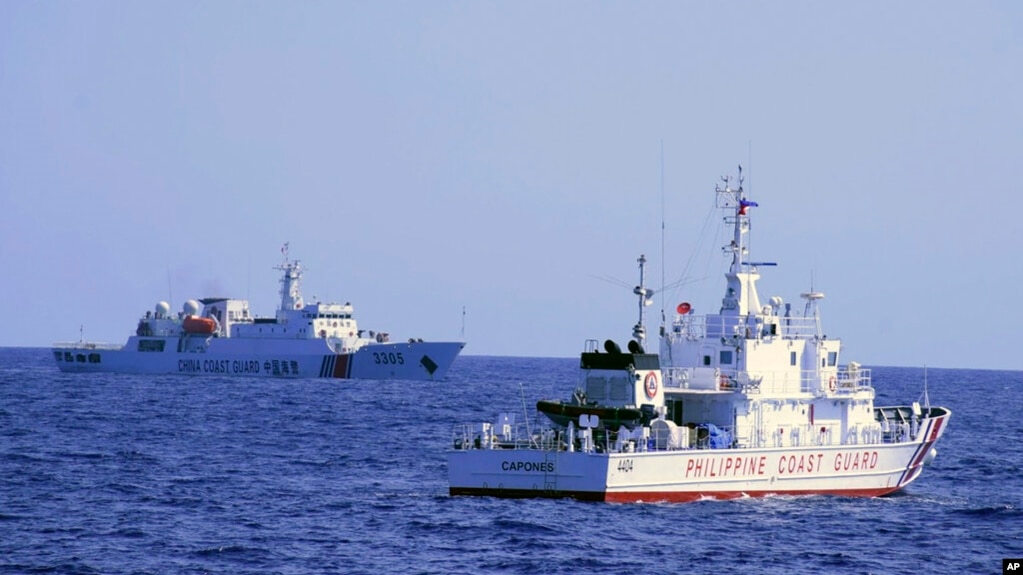
China claims sovereignty over the entire South China Sea, including its rich fisheries and undersea mineral resources. That has brought China into an increasingly tense territorial standoff with the Philippines, Vietnam, Taiwan, Malaysia and Brunei along the busy shipping lane.
China's occupation of Scarborough Shoal, known in China as "Scarborough Shoal", prompted the Philippines to submit the dispute to international arbitration before Duterte came to power. In 2016, a UN-backed tribunal invalidated most of China's claims and said China had violated Filipinos' right to fish in the shoal.
China dismissed the ruling as a hoax and continued to ignore the court's ruling, but allowed Filipino fishermen to return to shoal fishing under Duterte.
In March, Adm. John Aquilino, commander of the U.S. Indo-Pacific, told The Associated Press on a U.S. Navy reconnaissance plane that despite promises not to do so by Xi Jinping, China had already scrambled for the construction of the disputed Spratly Islands in the South China Sea. Three of the seven islands are fully militarized.
The weapons systems China has built on the artificial islands include anti-ship and air defense missile systems, laser and jamming equipment, and military aircraft.
China responded, "It is the right of every sovereign country to deploy necessary defense facilities on its own territory, in line with international law, and beyond reproach."