The epidemic situation in Shanghai is serious, and the closure and control measures originally scheduled to be lifted at 3:00 a.m. on April 5 continue to be extended. Experts believe that continuous and strict "zeroing" will reduce consumption, which will also affect the global supply chain, and the Chinese government's measures to stimulate the economy will also be difficult to achieve the annual growth target.
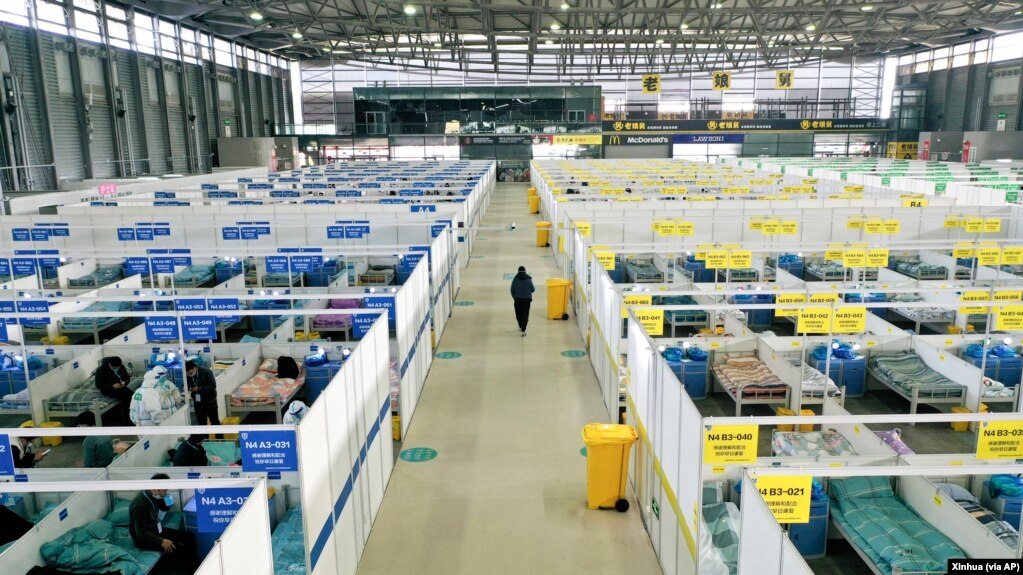
Shanghai, which was once a successful model of China's epidemic prevention, is now rapidly rising and has entered a state of closure. Chinese Vice Premier Sun Chunlan went to Shanghai on April 2, emphasizing the need to adhere to the general policy of "dynamic clearing" without hesitation and unswerving, and step up efforts to carry out inspections that should be checked, collected as received, separated and treated as needed. .
After Sun Chunlan went to Shanghai to announce her adherence to the zero-clearing policy, the city conducted a new round of nucleic acid sampling on April 4, and continued to implement lockdown management and strictly implement "staying at home".
Earlier, at a press conference on epidemic prevention held on the morning of March 26, Wu Fan, deputy dean of Shanghai Medical College of Fudan University, said that "Shanghai cannot be closed down" because it is to avoid impact on the global economy. However, on March 27, Shanghai was bounded by the Huangpu River, and Pudong and Puxi were blocked in turn. However, after a whole week of "mandarin duck pot-style" closure of the city, the epidemic situation in Shanghai has not improved, but has reached a new high.
The Shanghai Municipal Health Commission reported this morning that on April 7, Shanghai added 824 new local confirmed cases of new coronary pneumonia and 20,398 asymptomatic infections.
Liu Mengjun, director of the Mainland China Institute of the China Economic Research Institute, said in an interview with VOA that the impact of the strict city closure on the city of Shanghai itself bears the brunt of the impact on the job market.
He said: "In fact, once the city is closed, the first thing that will be affected is the city's service industry, because the service industry depends on the exchange of people. The closure of the city will not allow you to go shopping or go to school, and it will also affect the supplementary education industry, catering, tourism, movies, leisure and entertainment, The education industry is almost shut down, and the media cannot go to the site for interviews. The service industry is the main force in creating employment opportunities in several large cities, including Shanghai. These employees are the mainstream of urban consumption and economic operation. It will directly impact the future consumption capacity.”
Liu Mengjun pointed out that in the manufacturing and technology industries, if employees are isolated in industrial zones or industrial parks and prohibited from moving outside, the operational capacity of the industry can indeed be maintained, but in the service industry It is clearly not a feasible solution.
Luo Qingsheng, chief executive of the Taiwan Institute for International Strategy, believes that the nature of this wave of viruses is different, and the policy of strictly closing the city to zero may be delayed for a long time and will hit many industries including the service industry.
He told the Voice of America: "I am afraid that the 'clearing' measures this time will not be completely controlled in about half a month to 20 days at most, because the mutation of this wave of viruses is too strong. , and no perfect prevention has been done before. Shanghai is such a big city, and it is a big challenge to achieve a complete 'clearing'. I think it is very likely that the 'clearing' failed and was forced to not Suspension and continued closure of the city, and finally forced to coexist with the virus, and such a delay to the end will have a very heavy blow to Shanghai’s economy, and the impact on the service industry, transportation industry, and overall production will be very large.”
According to the analysis of Xie Tian, a professor at the University of South Carolina's Aiken School of Business, Shanghai's annual gross domestic product accounts for 4% of China's. In the past year, only Shanghai's fiscal revenue and expenditure were positive, while the other 30 provinces and cities The autonomous regions are all in deficit, and Shanghai has the role of helping or supporting other provinces, municipalities and autonomous regions. Once the city is closed, it will hit China's economy hard, and it will also cause supply chains to break.
Shanghai is China's economic, financial, aviation, port and logistics center, as well as a global financial and trade center. In order to prevent the closure of the city from seriously affecting the economic lifeline, Shanghai's airports, railways, international freight and stock exchanges remain open. Shanghai Port, the world's largest port, will continue to operate 24/7 as usual, and the international operations of the foundry center will not be affected.
Liu Mengjun, director of the Mainland China Institute of the China Economic Research Institute, said that Shanghai is not only an important financial center, but also an important international shipping center and high-tech center. Therefore, the Chinese authorities still hope that while implementing strict epidemic prevention measures, they will try their best to maintain its economy. Normal operation, so Shanghai has previously insisted not to adopt large-scale blockade measures. He said that the recent mode of taking turns to close the city in Pudong and Puxi is still trying to maintain the normal operation of its financial industry, but I am afraid that other industry models supporting the financial industry will be greatly affected, which will eventually affect the financial industry. Industry.
He said: "For example, the stock market trading and other industries that do not need to rely on human labor and can use ICT (information and communication technology) have not seen any signs of being greatly affected. However, I don't think it can be supported for too long, because the employees are employed. It is necessary to commute to and from work. According to the previous model, employees are allowed to eat, sleep, and live in the company. In reality, it cannot be maintained for too long, and it will still have a negative impact on the financial industry. Shanghai is the fourth largest international financial center. If we want to surpass Hong Kong, which ranks third, this strict zero-clearing policy will not be able to last for too long.”
Liu Mengjun pointed out that taking the unicorn company with a market value of more than 1 billion US dollars within 10 years of establishment as an example, it ranks No. 1 in the world. In China, the top three urban unicorn companies are Beijing, Shanghai, and Shenzhen, all of which have the background of financial centers. Previously, due to the outbreak of the epidemic in Hong Kong, Shenzhen, which has a high degree of linkage, entered the city and severely affected the supply chain. From the example of Shenzhen, it can be estimated that if the closure of the city in Shanghai continues, it will probably be overwhelmed.
The "31st Global Financial Center Index Report" jointly compiled by China's national high-end think tank China (Shenzhen) Comprehensive Development Research Institute and the British think tank Z/Yen Group was released on March 24. In terms of facilities, financial industry development level, reputation, etc., the world's major financial centers are evaluated and ranked. The top ten are New York, London, Hong Kong, Shanghai (4), Los Angeles, Singapore, San Francisco, Beijing, Tokyo and Shenzhen.
Luo Qingsheng, CEO of the Taiwan Institute of International Strategy, said that if it is simply the same as the previous state of closure, production, sales, and services will be postponed for a short period of time, and retaliatory consumption will occur after the closure of the city. The national economic impact will not be too great. But this "zero" probably will not be so smooth, and it will not only impact China's economy, but also have a global impact.
He said: "This will be a knock-on effect. If the 'zero' effect cannot be achieved quickly and the closure of the city continues to be delayed, it will cause chaos in the global supply chain and affect the economies of the United States and Europe. Now the United States and Europe have When the epidemic is under control and the economy is going to recover, the global supply chain will be in chaos due to China's insistence on 'zeroing out'. If the economic growth of Europe and the United States slows down due to this, it will affect China's economic growth."
Economic stimulus policies Difficult to achieve results
in time Before the implementation of screening and screening in Shanghai, many investment banks had predicted that China's economic growth rate this year would not be optimistic under the impact of the Omikron epidemic and the Russian-Ukrainian war. Lu Ting, chief economist at Nomura Securities in China, pointed out in the latest report that China may not reach the target of 5.5% annual growth this year.
Luo Qingsheng, chief executive of the Taiwan Institute for International Strategy, said the 5.5 percent annual growth target was almost impossible. He pointed out that Wall Street bank Morgan Stanley (Morgan StanleyS) downgraded China's full-year GDP forecast from 5.1% to 4.6%, and the economic outlook for the second quarter is at risk. To this end, he believes that China should have corresponding measures.
He said: "The Chinese government will definitely take some more measures to stimulate the economy, such as more accommodative policies including financial, or even learn from the United States to send money directly. If the effect of these measures is not enough, it will continue to loose policies, such as In addition to the RRR cut, the interest rate will really be lowered, and if the recession continues, the decline will be larger and larger; if the consumer market continues to be unsatisfactory, stronger measures to stimulate consumption will be introduced. Therefore, it can be estimated that these measures to stimulate the economy will be sooner or later. You can see the effect.”
Liu Mengjun, director of the Mainland Institute of the China Economic Research Institute, also believes that facing the cost of Shanghai’s zero policy, the Chinese government is bound to introduce measures that can stimulate the economy, but the effect may be limited.
He pointed out that almost all coastal cities have been closed due to the outbreak of the epidemic. Now, financial and technological cities like Shanghai have implemented strict zero-clearing. It is estimated that it is unlikely to completely solve the epidemic problem by May. For now, it looks like the only thing you can count on is a big stimulus package in the third quarter, when the 20th Party Congress takes place. But at that time, it was the autumn and winter periods when the virus was most active, and it was likely to face the problem of whether to clear it again. If the zero-clearing policy is implemented throughout the 20th National Congress of the Communist Party of China, it will be difficult to highlight China's so-called 'system superiority', so the economy must be stimulated in the middle of the second quarter.
He said: "The measures to stimulate the economy mainly face several problems. First, the external links are changing. The Russian-Ukrainian war does not know when it will end. The United States still continues to impose economic sanctions. The external risks are not small and can only rely on domestic demand. There are three ways to stimulate the internal circulation. The first is consumption. However, due to the unstable employment caused by the epidemic and the closure of the city, it is difficult for household consumption to increase significantly. In addition, it can rely on industrial investment and government fiscal stimulus. Investment in private industries must rely on a lot of subsidies, but The service industry is not very optimistic, and probably can only rely on investment in manufacturing and infrastructure.”
Liu Mengjun pointed out that in order to reach a considerable scale in the third quarter, looser currency may be one of the effective means to stimulate the economy. However, it is not easy to achieve the target of 5.5% annual growth. If Shanghai wants to continue the zero-clearing policy, or other major cities also implement the zero-clearing policy, Xi Jinping will face the unsolvable problem of economic downturn and strict epidemic prevention policies.