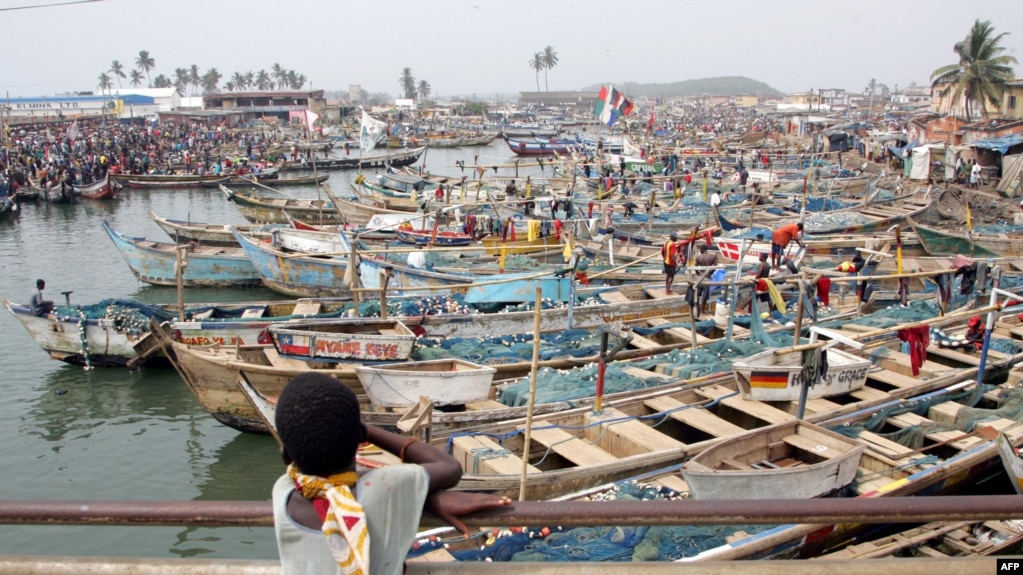
This is a classic postcard image of Ghana: brightly coloured, narrow wooden fishing boats pull into the piers of seaside villages, bringing their daily catch. But this way of life is increasingly under threat. Chinese vessels engaged in illegal fishing are depleting fishery resources and sometimes even selling fish back to local communities whose livelihoods and food security are undermined, a new investigation shows.
According to the NGO Environmental Justice Foundation (EJF), China is the world's largest fish producer and has the largest ocean-going fleet (CDWF) - officially 2,701 vessels, but the real number may be more than that Thousands of boats - many engaged in illegal, unreported and unregulated fishing.
The group's report this week found that about 90 percent of Ghana's industrialized trawl fleet is actually owned by Chinese companies that use local "nominal" companies to register as Ghanaian companies and circumvent the law.
"The Environmental Justice Foundation has uncovered ongoing incidents of illegal, unreported and unregulated fishing and human rights abuses linked to Chinese ocean-going fleets in West Africa, particularly Ghana, where Chinese companies use elaborate tactics to hide alleged the ultimate beneficial ownership of Ghanaian domestic vessels. These strategies include the establishment of joint ventures, shell companies and subsidiaries,” the report said.
While China's ocean-going fleet also operates in waters off Asia and elsewhere, its activities in Africa account for 78.5 percent of its approved offshore fisheries projects, the Environmental Justice Foundation found in an analysis of data from China's Ministry of Agriculture and Rural Affairs.
The trawlers of China's ocean-going fleet fish about 2.35 million tons of fish in West Africa each year, accounting for 50% of China's total ocean-going fishing, worth about $5 billion.
The Environmental Justice Foundation said China's gains often hurt the interests of countries such as Ghana, Sierra Leone, the Gambia, Senegal and Guinea-Bissau. The West African region reported the highest number of illegal fishing incidents between 2015 and 2019.
“Illegal fishing and overcapacity in the trawl industry in Ghana has had a disastrous impact on coastal communities across the country,” Max Schmid, chief operating officer of the Environmental Justice Foundation, told VOA by phone. About 80 to 90 percent of local fishermen in Ghana report that their income has decreased over the past five years.
According to the Environmental Justice Foundation, women who are typically responsible for processing and selling local catches often suffer the most from lost income. They turned to the sex trade, a phenomenon known locally as "sex for fish".
At the same time, locals working on Chinese trawlers are often subjected to human rights violations. The 10 Ghanaians interviewed by the Environmental Justice Foundation said they had all "experienced or witnessed physical abuse by the Chinese captain".
It has also become more common for Chinese fishing boats to catch small ocean-going fish, which are then sold to communities for profit, the group found. These fish are the main fish caught by small-scale fishermen.
In Ghana, neither the Navy nor the Ministry of Aquaculture Development responded to requests for comment.
The Chinese embassy in Accra did not answer calls to VOA and did not respond to emails seeking comment.
However, China has repeatedly denied any wrongdoing. An article last year in the Chinese state media Global Times "refuted Western media rumours of 'illegal fishing in China' and said Beijing had issued a moratorium on squid fishing and had in fact tightened regulations on deep-sea fishing vessels in recent years. Supervision.
Another article in the paper said China has done more than any other country to protect the marine environment and resources. Separately, China's state news agency Xinhua cited Chinese-funded developments such as a new fishing port complex in Ghana's capital Accra, saying it would "greatly improve the working and living conditions of local fishermen."