Analysts say China's patience over Russia's war on Ukraine has set back China's cherished relationship with the European Union, despite initial growth late last year.
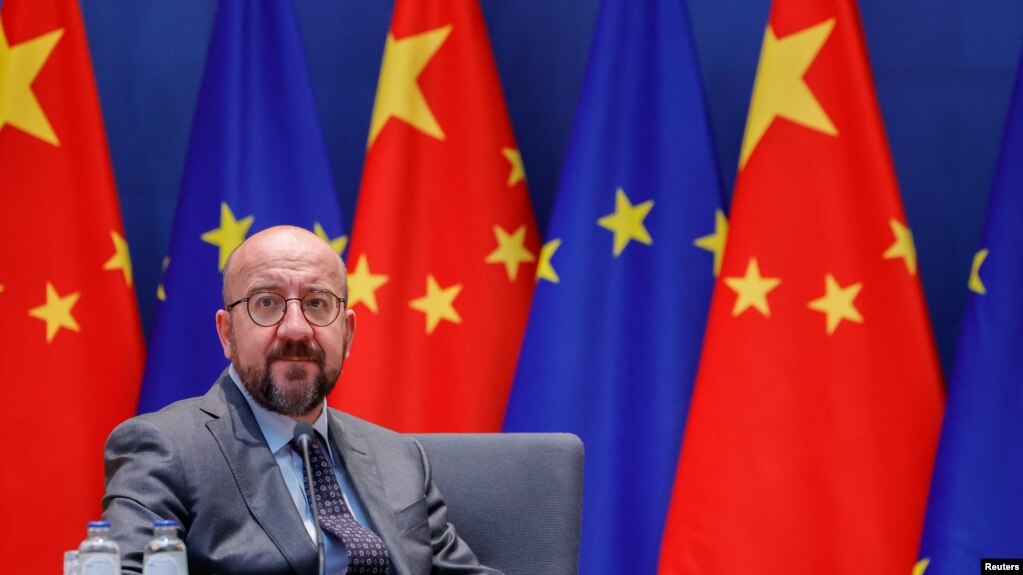
The European Union warned China on April 1 at its first EU-China summit in nearly two years not to support Russia's war in Ukraine or interfere with international sanctions against Moscow. In a two-hour video conference, EU officials demanded that China, as a member of the United Nations Security Council, fight for Russia to stop the war.
China, despite its close economic and strategic relationship with Russia, approached the war as a neutral country.
"This adds to the collective anger in the EU over China's support for what appears to be a blatant violation of international law," said Zhang Jiasong, an associate professor at the Rajaratnam School of International Relations in Singapore.
Russia began its invasion of Ukraine on February 24 and continues to bombard it despite negotiations and Western Economic sanctions imposed by the government on Moscow.
Chinese President Xi Jinping spoke with two senior European officials in October to improve relations. Although the two sides did not reach a substantive deal, they had a friendly chat after the European Union froze an investment deal with Beijing in early 2021 and sent a parliamentary delegation to Taiwan.
Analysts told VOA last year that China was looking to forge trade and investment ties with various European countries after five years of confrontation with its Cold War rival, the United States.
China-EU relations have improved slightly after the October meeting, with China seeing the EU as a "more acceptable" Western face than the US, Zhang said. He said some leaders of the EU's 27 member states had become more "pragmatic" with China.
Russian President Vladimir Putin's war on Ukraine has set back China's search for European friends, said Sean King, senior vice president at Park Strategies, a New York-based political intelligence firm. "This is a new day in Europe, not a welcome day for the two dictators, Putin and Xi," he said.
China's trade restrictions on Lithuania last year and market access for European companies were again central to Europe on April 1. thorny issue.
Lithuania offended Beijing by letting Taiwan use its name to open a de facto embassy in Lithuania.
Stephen Nagy, a senior associate professor of political science and international studies at International Christian University in Tokyo, said European leaders viewed China's actions against Lithuania as undermining their unity and undermining "values" such as democracy. China retaliated in 2020 for the Czech Republic's close ties with Taiwan.
"The economic coercion against Lithuania and the Czech Republic is evidence of China's intimidation of European member states," Nagy said.
EU leaders raised the issue of China's treatment of ethnic minorities such as the Uighurs in the Xinjiang region at the summit.
On the economic front, EU leaders held talks with China on April 1 to discuss making their relations "more level", creating a "level playing field" and rebalancing "bilateral Trade and investment relations.”
said Jayant Menon, a visiting senior scholar at the ISEAS-Yusof Ishak Institute’s Regional Economic Research Program in Singapore, European leaders were dissatisfied with the Chinese government’s controlling position in major companies and subsidies to these companies.
"I think these are the things that China is generally considered to be problematic in international trade, and I think it's picked up by the Europeans as well," Menon said.
China remains the EU's number one trading partner and billions of dollars a year. source of direct investment. But their issue "has stalled" after eight years of negotiations on the EU-China Comprehensive Investment Agreement, said Chen Yifan, an assistant professor of diplomacy and international relations at Taiwan's Tamkang University. Negotiations froze last year.
The agreement would deal with market opening and forced technology transfers against European investors.
China softened its rhetoric after last week's summit. Beijing's Xinhua news agency said Monday that the European Union and China must "take the lead in defending the international system with the United Nations at its core" and abide by international law. Xinhua quoted Xi as saying China would "continue to work on deepening reforms and further opening up" its markets.